THE BATTLES RAGING AROUND AND WITHIN US
Liner Notes by Stephan Eicke for the 2026 album release of Loek Dikker’s original scores for Mady Sacks’ film Iris and Peter Delpeut’s film Felice… Felice…
Around Us
Both films featured here revolve around an individual entering foreign territory. For Iris, the veterinarian who gives the first film featured here its title, this foreignness is largely figurative. For years, the thirty-year-old has lived with her older husband, an architect, in a big city. Tensions have started to simmer. What appears to be a comfort feels increasingly like a gilded cage. Though she enjoys her job as a veterinarian, she has long harbored larger ambitions. An unexpected inheritance offers escape. Eagerly she leaves her husband to move to an unfamiliar village to begin again.
The locals’ response is more than chilly. The film joins a lineage of works built on the clash between community and outsider: Sam Peckinpah’s film Straw Dogs, Thomas Vinterberg’s The Hunt, and Tarjei Vesaas's novel Kimen (The Seed). Iris stands alone against a collective. She learns quickly, tends livestock with care, and tries not to offend – yet she is unable to win trust. It comes as it must: an implosion upsets her life. She can never again be the women who first arrived in what she hoped would be her haven.
The story draws less on Straw Dogs, a controversial film for its misogyny, than on a European news story. Mady Sacks’ movie is the opposite of Peckinpah’s work. Here, too, the female protagonist is raped. But Iris refuses victimhood. She quickly takes matters into her own hands. She acts.
Premiering in 1987, the film was a commercial success in the Netherlands and reinforced Monique van de Ven’s standing as a versatile film star. Living in Los Angeles with her then-husband, cinematographer and future director Jan de Bont, she was attempting an international movie career. While she didn’t break through in Hollywood, at home she enjoyed great acclaim. Iris generated headlines and even inspired a television series in the early 1990s.
Loek Dikker’s score for Iris proved central to the film’s impact. The composer had started writing for film only a few years before. The buoyant main title – modeled on a Latin American bolero – initially suggests lightness. For Dikker, it expressed Iris’s vitality. “I found reasons to imbue the opening with references to a road movie,” the composer remembers. “Iris is on the way to her first job. She is young, full of expectations.” As hostility mounts, the music darkens. It reflects the unease of her rural surroundings. In the finale, acceptance brings the bolero back. It completes the arc.
In instrumentation and harmony, the main title faintly recalls Ennio Morricone’s lounge track La Lucertola. Dikker explains that there is no direct influence. True enough, the melodies differ entirely. “I used the flute rhythmically,” the composer points out, “and I wrote a long, flowing quasi-texted melody line in the style of the bossa nova and the American Songbook.” A jazz musician by training, he feels close to Latin idioms: “In my late teens, I played with a Latin American band from Suriname. Today Latin American music is international. It has detached itself from its territorial origins.” His true model was Francis Lai, particularly Lai’s score for Claude Lelouch’s Un Homme et une Femme. Dikker sought a similar brightness and delicacy.
The bolero frames the film structurally. Beneath it runs a darker current. The main underscore contrasts Iris’s integrity with the ambiguity of those around her – any of whom might be her rapist. “The musical score handles this conflict in a considerate, suspenseful way,” Dikker summarizes, adding: “Of course some of the recognizable musical elements from the main titles are also used also in the dark musical passages.” The resulting blend gives Iris color and range. It is one of Dikker’s strongest achievements. Ten years later, he would undertake a project especially close to his heart.
Within Us
Peter Delpeut’s film Felice… Felice… (1997), loosely inspired by Felice Beato, explores the tension between illusion and truth. They are forces locked together, each straining for dominance like two bulls in an arena.
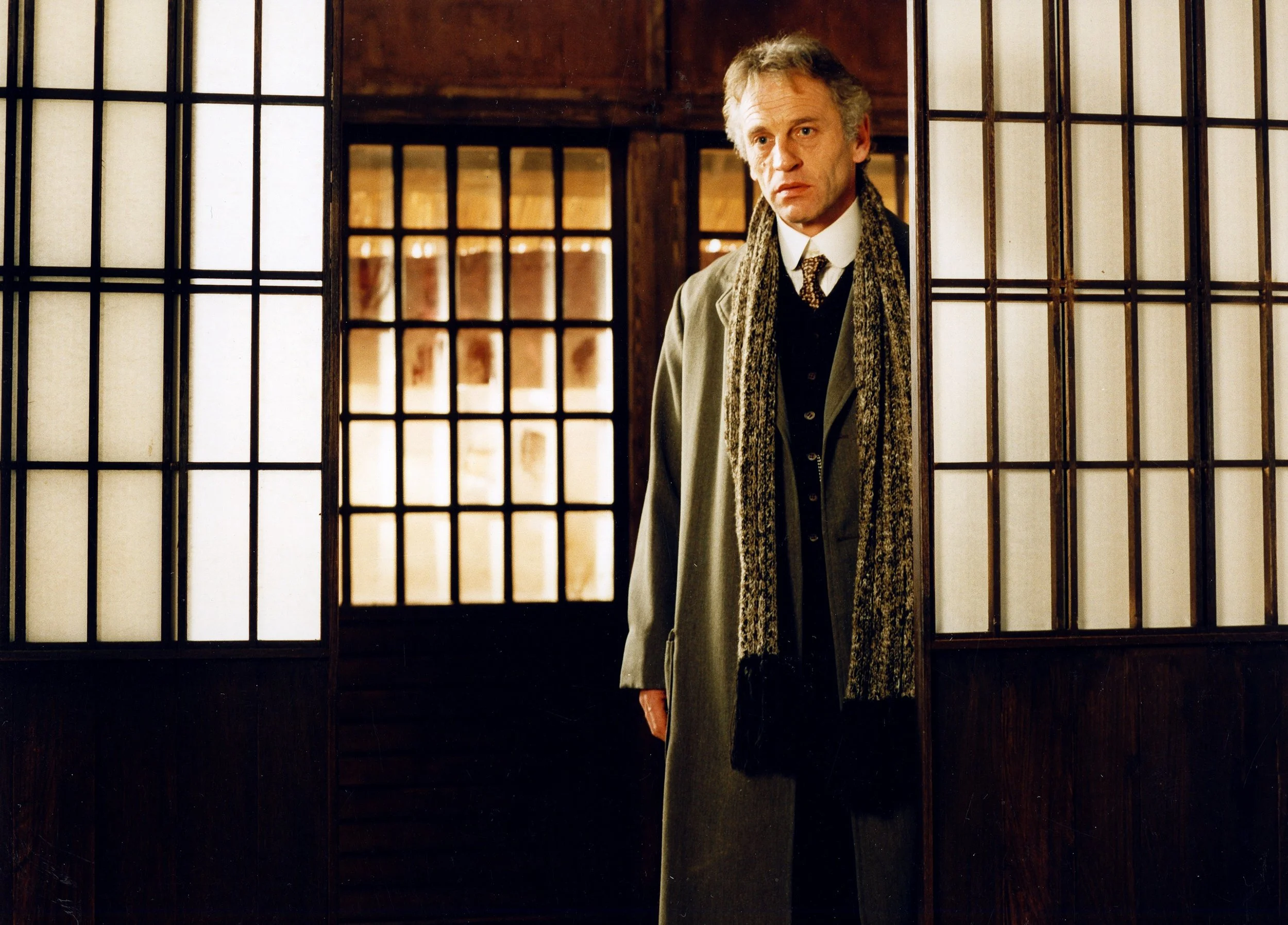
In 1895 (the year of the first film screening), photographer Beato returns to Japan after some time away. Once a pioneering photojournalist who captured raw life in Asia, he has abandoned photography. It had been his way of connecting with people. (The film – shot entirely in a studio – elegantly weaves in photographs from Beato and his contemporaries.) Johan Leysen plays him with sorrowful gravitas: a man hollowed by loss, still mourning his wife, O-Kiku, whom he met in the when he first set foot in Japan.
One afternoon upon his return, Beato visits a former student of his who photographs customers before a painted Mount Fuji, though the real mountain stands nearby. It is ironic. “People prefer the painting,” he shrugs. “It is prettier.” This crystallizes the film’s theme: People often choose the illusion. Beato has started to grapple with this fundamental truth he previously had tried to ignore. He once chose his own “painting” of O-Kiku, an image shaped of longing and incomprehension and misunderstandings.
One day he had left her, never to return. Now he seeks closure. Japan has changed, though. So has he. Beato feels adrift. In conversations with old acquaintances, he confronts a painful realization: he never knew his wife in the first place. Their marriage was shadowed by mutual misunderstanding. Customs that aim to show respect in Western culture are eyed suspiciously in the East. Sometimes they are seen as downright insulting. Gradually he is understanding that “his” O-Kiku was an illusion, as artificial as the painted Mount Fuji. It may have been preferable to the new mosaic that starts to assemble itself in front of his eyes. “Foreigners,” a Japanese friend smirks, “you never really know. You never can.” Still, he wants to see clearly.
Memory erodes her further: she as a presence before she was a recollection. Eventually, she became a sensation. At the end of Beato’s search lies a quiet insight: photography can not adequately grasp human essence; only fragments, shifting like patterns in a kaleidoscope. As motion pictures emerge in Europe, Beato senses a possible redemption. Cameras promise to capture life in all its richness. Now, there is movement, continuity, life. After meeting the now re-married O-Kiku for the last time, he listens anew to the world: “Everything was moving,” he sighs. “Everything was alive.”
Director Peter Delpeut’s gentle, wise and moving meditation on the nature of memory explores a changing Japan, cultural differences, and our fear of forgetting and of being forgotten. It demanded a delicate score. Composer Loek Dikker had the difficult task of developing music that captures Beato’s restlessness, his hope and desire, while at the same time providing the appropriate musical accompaniment for the photographs of a lost place. One of the early central questions for the director and his composer was how strong the influences of traditional Japanese music should be. Loek Dikker sought a balance between the East and the West. “The story unfolds in the Far East,” he explains, “yet many scenes feel Western because the main character is European. I wanted the music to have an indirect presence; to fuse both worlds.”
Dikker’s contemplation didn’t end here. He wanted his music to flow almost imperceptibly, as he elaborates: “Many scenes are fragile like thin glass. This was an extra complication for me.” The film is tightly controlled. Its emotional register is hushed. Feelings accumulate over the course of the film before they break. One barely notices the weightiness of emotions from scene to scene. By the time the end credits start rolling, Felice … Felice … hits its audience with full force. It has become unable to contain the weight of emotions any longer. Dikker wanted his music to be as delicate as the film was: “The music shows emotion sparingly. Much of it remains in the same tempo. It gently flows along like water in a stream. Elements of traditional Eastern music surface only occasionally. I wanted to keep the viewer attentive to the subtlety of the exchanges between the characters in the film.”
Dikker treated stage scenes and the archival photographs alike, as integral drama rather than illustration. The historic images are part of the storytelling. Dikker used a small symphony orchestra because he deemed the size of the ensemble appropriate for the specific color palette it brought with it: “It is incredible how small a feeling forty players can express, and how vast a feeling a single instrument can convey. That is the privilege of music, I’d say.”