DON’T BE AFRAID OF NOT GROWING OLD
Liner Notes by Stephan Eicke for the 2026 album release of Peter Salem’s original score for Nancy Meckler’s film Alive and Kicking
Shortly after the death of their friend Ramon, Tonio and Millie are standing outside the hospital. She asks him if he remembers how they used to smuggle chocolate in for a particular friend. They didn’t, Tonio corrects her. They did that for somebody else. Nobody can keep track. This is the age of HIV and AIDS before the first retroviral drugs were made widely available. People are dying at a dizzying speed. At Ramon’s funeral, somebody sighs that it’s his fourth funeral in a month. His partner replies he hasn’t even seen four movies that month.
Alive and Kicking, one of the most underrated gems of 1990s British cinema, is best in these small moments. They cut deep because they get at something profound by distilling the ungraspable, abstract horror into familiar experiences and recognisable observations, some of which the film infuses with subtle, pitch-black humour. Tonio, a seropositive ballet dancer, tries to deal as best he can with the nightmare he wakes up to every single morning. He uses jokes to keep his fears at bay. With sharp quips, he avoids looking inward. He also tries to keep others at a distance. Masks have become familiar to him over the years. He reveals at one point that his name isn’t Tonio after all but Anthony, and that he isn’t from Italy but Croydon.
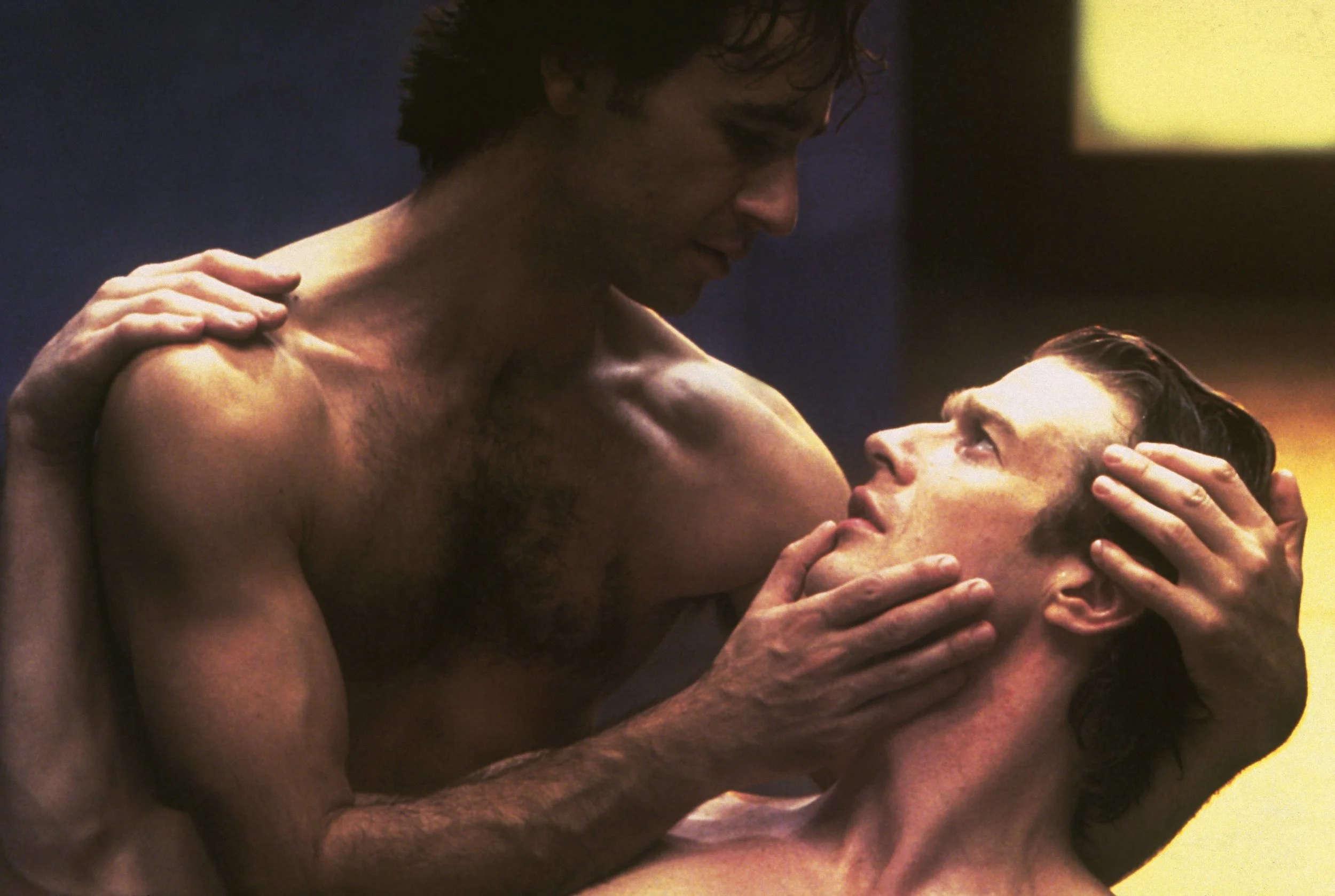
Partly because of his HIV infection, Tonio is afraid of committing himself to a new relationship. At the same time, he refuses to let the virus define him. It’s a delicate balancing act, one that finds its allegory in the film’s extended dance sequences. “Why aren’t you angry,” is a recurring question in Nancy Meckler’s acute, sensitive film. It is asked repeatedly by Tonio’s new acquaintance Jack. He knows the answer, of course. It is obvious to him that Tonio tries everything to keep himself from falling apart, to let nothing and nobody get close. And how would anger help anyway?
Tonio and Jack meet in a club where the latter begins to flirt aggressively with the former. Jack won’t allow Tonio’s diagnosis to dictate his feelings for him. The virus will not forbid him to fall in love with the dancer. Tonio, though, is decidedly more reluctant. He doesn’t want to commit. Thus, he starts performing an eloquent, complex dance to stop himself from entering a relationship.
Accordingly, Tonio and Jack engage in a game of push and pull. They are fond of each other, but Tonio is afraid to fall in love and then lose another partner, either through his own death or that of Jack. What if they fall in love only for Tonio to die or infect Jack? The pain, Tonio has concluded in quiet moments of contemplation, is simply not worth a few months of happiness. Or is it? Toward the end of the film, the ballet’s choreographer Luna, who suffers from dementia, assures him: “Don’t be afraid of not growing old.” Luna has had a moment of clarity in which she acknowledges her memory loss. In one swift sentence, she summarises the message of the whole film. Live life fully. Don’t let fear hold you back. As a therapist (and a sensible human being) Jack is aware of Tonio’s intricate performance. He challenges him and, in the process, permits him to drop his masks.
Tonio decides to live his life the best way he can under the circumstances. He is lucky in a sense: his ballet company adapts to his condition and quickly changes the performance to allow Tonio to appear on stage even though he is barely able to keep himself upright. Luna’s dementia is apropos: her illness here is a symbol that underlines the film’s main point. It asks of its characters to somehow deal with the impossible. The illness (or infection) is there. It is undeniable. How, then, does one address it and make sure the show that is life can go on? One works with it, not against it. Luna’s repetitions, her mental fog, are eventually used to everybody’s great advantage. Tonio and Jack make their relationship work, too. See the other. Recognise their pain and longing. Help them drop their masks by making them feel safe.
The film’s high point is the challenged performance of a challenging ballet. It is also the high point of Peter Salem’s score: the British composer is best-known for his ballet compositions, among which are A Streetcar Named Desire for Scottish Ballet, Emma Bovary for the National Ballet of Canada, and The Little Prince for Ballet X Philadelphia. Alive and Kicking was his feature film debut – and what a thankful opportunity it was, a film that allowed a classically-trained composer to spread his wings and craft an elaborate score with a ballet sequence as its backbone.
At the time of filming, director Nancy Meckler was also the Artistic Director of Shared Experience Theatre Company in London, England. She had worked on several productions with Peter Salem over the years, and deemed him the right choice for her feature because, among other reasons, he was not an experienced film composer. Salem remembers: “Her productions always included choreographed physical sequences as part of their dramatic language. The fact that this was a dance film and that the climax would be a dance piece (and choreographed by another Shared Experience collaborator, Liz Ranken) meant that in many ways we were in familiar territory. I had also composed for contemporary dance, and worked for London Contemporary Dance as an accompanist by this time.“
Meckler and Salem also shared a language. Both dislike sentimentality, which meant, among other things, that they agreed to underscore visual sequences and montages rather than scenes of dialogue to strengthen an emotion already suggested by the respective words and gestures. To put it another way, neither Salem nor Meckler were keen to put a hat on a hat and thus be overly manipulative. They chose instead to trust their audience. Correspondingly, Meckler and Salem agreed to infuse the film, particularly its montages, with driving, playful, upbeat music. Neither wanted the music and therefore the characters in the film to appear “self-pitying,” as Salem puts it. Many scenes were left unscored, such as the death of Ramon, Tonio’s close friend. “Taking everything away is often the strongest option,” says Salem. He continues: “Silence draws the viewer in, creates tension and in the case of the death of Ramon emphasises absence.”
Occasionally, Meckler and the producers disagreed with Salem. His original opening for the film was scrapped. The composer had written and recorded drumming for the title sequence, “probably because of my background working in contemporary dance at the time,” he surmises. Moreover, he felt that it captured Tonio’s energy and drive. To his initial disappointment, it was deemed not engaging enough as the opening of the film. Instead, he used a piece (now called The Workout on the album), which he had originally envisioned solely for the dance rehearsal montage in the film. The theme then became the backbone of the ballet sequence, where it can be heard in all its glory.
Writing the music for the ballet sequence was a technical challenge because it wasn’t shot to Salem’s music. The composer explains the complex and rather unusual process behind the shoot: “Some Vivaldi was used to help set the ballet, create a mood, tempo, etc... Rather than it being shot as a continuous movement sequence there is a great deal of close up and storytelling within the dance piece. Much of its structure was created in the edit. This meant that I could then score the resulting sequence as a piece of dance and as a piece of narrative film. As I have now discovered, having worked on numerous contemporary ballets, this is exactly the opposite way around to the way composing for dance generally works. It’s usually assumed that the music will come first.”
Alive and Kicking is an astonishing feat of a score, particularly considering that it was written by a composer who at the time was inexperienced in writing for the big screen. We are delighted to make Peter Salem’s work available with the support from Channel4. Since Alive and Kicking is a rather sparse score, we decided to add other titles from Salem’s oeuvre, namely a Quartet he wrote in 2012 and selected pieces from the 2003 BBC production Caravaggio which ran as the first part of the Simon Schama’s show The Power of Art, a docuseries with re-enactments. (Caravaggio features a young Andrew Garfield in a minor role.) Rather than release the whole score, we decided to focus on the pieces that showcase Salem’s astonishing choral writing which he fused delicately with electronic elements.